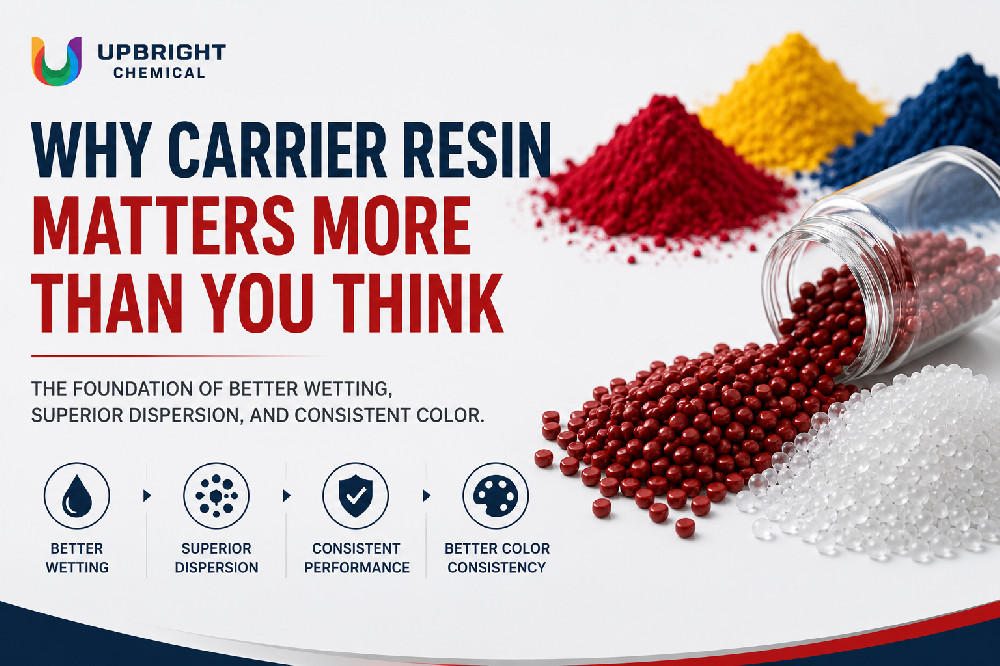
Wetting takes place before effective shear
The carrier resin is not simply a vehicle that holds a high pigment concentration. It provides the first meaningful contact between the pigment surface and the polymer system, and that contact influences how readily agglomerates can be separated.
Depending on the process, a carrier supplied in powder form may distribute more evenly around the pigment before melting than conventional pellets. The appropriate choice still depends on feeding equipment, handling requirements and the complete formulation.
Match the melt behavior to the process
Melt viscosity, softening behavior and residence time determine whether the compound develops enough distributive and dispersive mixing. A carrier that melts too late or behaves very differently from the final polymer can leave visible defects even when the pigment grade is suitable.
For polyolefin applications, carrier compatibility with the final PE or PP system should be discussed alongside pigment loading and expected let-down ratio.
Evaluate the complete compounding system
Carrier resin, pigment grade, premixing method, feeding sequence and screw design form one connected system. Changing any one element can affect the apparent performance of the others.
Laboratory extrusion followed by injection-molded plaques and filter-pressure testing provides a more useful basis for comparison than resin price alone.